
The United States has said that drone strikes are "legal and ethical" tools against Al Qaeda terrorists in Pakistan, dismissing Islamabad's concerns over the attacks.

The law, which dilutes the Indian capital's autonomy and emasculates the elected local government's powers, will be a political millstone for the party for the next elections, reports Aditi Phadnis

The former Chief of Army Staff said India faces the most complex threats and challenges spanning a full spectrum of possible conflict -- from nuclear to sub-conventional -- but asserted that the armed forces are ready to deal with them.

India is apprehensive about the Taliban's return as it would mean loss of access to Baluch rebels and help to the restive tribals of Waziristan. This would be a setback to the Indian strategy of returning the compliments of death by a thousand cuts to Pakistan, notes Colonel Anil A Athale (retd).
Brushing aside Islamabad's rebuttal, United States has fired fresh salvos charging Pakistan's military-run Inter Services Intelligence of not only supporting the Haqqani terror network but also 'encouraging' it to launch more brazen strikes on American installations in Afghanistan.
Giving in to its long standing demand, the United States has agreed to share drone technology and provide at least a dozen unmanned aerial vehicles to Pakistan.During his visit to Pakistan, United States Defence Secretary Robert Gates said that Washington is planning to provide some unarmed spy drones to Islamabad to encourage it to fight against militants on the Afghanistan border and do more in the region.
The United States has said Pakistan's civil and military leadership should have "its writ on its soil", making it clear that Islamabad needs to take more steps to tackle terrorism.
Tehrik-e-Taliban Pakistan's chief Hakimullah Mehsud has severely criticised the Pakistani justice system and its 'pro-American policies'. In a recently released video, he also vowed that the TTP will continue its struggle until Islamic Shariah is implemented in the country.

'He could indeed survive [the no confidence vote] even as he faces his biggest political test.'
Washington and Islamabad are looking more like enemies than allies in a war, thus threatening the US-led war on terror, says Amir Mir
In the strongest warning so far to Pakistan, the United States on Thursday said it is reaching the limits of its patience with Islamabad for allowing terrorist safe havens, specially the dreaded Haqqani network.
United States Secretary of State Hillary Clinton has warned Pakistan of "damaging consequences" over multi-billion gas pipeline with Iran, saying Islamabad could face sanctions if it went ahead with the ambitious project.
Pakistan Prime Minister Yousuf Raza Gilani on Thursday said Islamabad wants to have "excellent relations with the United States" and said both countries along with Kabul need to be "on the same page" in efforts aimed at boosting national reconciliation and stability in war-torn Afghanistan.
"This is a moment of opportunity. I hope both parties will make the most of it," former Secretary of State Madeleine K Albright when asked in an interview with PTI about the India-Pakistan relations after the formation of new government in Islamabad.
The United States, on Tuesday, denied reports that it has plans to seize Pakistan's nuclear weapons, saying it has confidence on the ability of Islamabad to provide adequate security for their atomic arsenal.
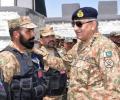
Prime Minister Khan, in his address, said Pakistan will never fight any other country's war in future and his government's foreign policy will be in the best interest of the nation.
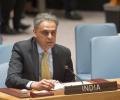
India's Permanent Representative to the United Nations, Syed Akbaruddin, on Thursday lambasted Pakistan for peddling a false narrative on New Delhi and said there are no "takers for your malware here".
The United States continues to negotiate with Pakistan on re-opening of the crucial NATO supply routes to Afghanistan that were closed by Islamabad after a cross-border NATO air strike killed 24 of its soldiers last year, the State Department said on Wednesday.
The growing influence of the Central Intelligence Agency and Pentagon in shaping relations with Pakistan was a key reason behind United States Ambassador Cameron Munter's decision to quit his post, the media in Islamabad claimed on Wednesday.

She asserted that people live in fear that Islamabad is going to have a coup.
Jamaat-ud-Dawah chief Hafiz Mohammad Saeed, blamed for the Mumbai terror attacks, has demanded that the Pakistan government should announce a date for parting ways with the United States and abandoning its war on terrorism.
The United States has moved hundreds of new troops to the Afghan area bordering Pakistan's insurgent-infested North Waziristan tribal region along with heavy artillery, helicopter gunships and sealed movement on the border, local media reports in Islamabad said.

Pakistan is once again becoming a frontline State in big-power rivalry. But this time around, Pakistan stands to gain out of its geography, observes Ambassador M K Bhadrakumar.

The talks between Singh and Esper came a day after Prime Minister Narendra Modi held a telephonic conversation with US President Donald Trump.

Pakistan's new Prime Minister Shahid Khaqan Abbasi is scheduled to address the UN General Assembly this week.
The United States is likely to turn up the heat on Pakistan following the alleged involvement of the Haqqani network in the Kabul attacks, says Tahir Ali.
Pakistan has complained to United Nations chief Ban Ki-moon that the geographical coordinates notified by India of the Sir Creek estuary are "inconsistent" with international law and "impinge" upon Islamabad's territorial limits in the disputed area.
United States has accused Pakistan's military-run ISI of providing financial, technical and physical support to extremist organisations and have give "concrete evidence" of the same to Islamabad, which has been facing American heat for a while.
The Pentagon on Tuesday said it had shared with Pakistan in recent years the indications of Islamabad's "complicity" with extremist groups, renewing top United States commander Admiral Mike Mullen's allegations that Inter-Services Intelligence was conniving with the Haqqani network in Afghanistan.

With the United States Senate voting to triple the non-military aid to Pakistan at $1.5 billion, India on Friday once again expressed concern over such funds being diverted by Islamabad to support hostile operations against it. External Affairs Minister S M Krishna, who is in New York to participate in the opening session of the United Nation General Assembly, said New Delhi was concerned as former Pakistan President Parvez Musharraf had himself disclosed startling facts.
